
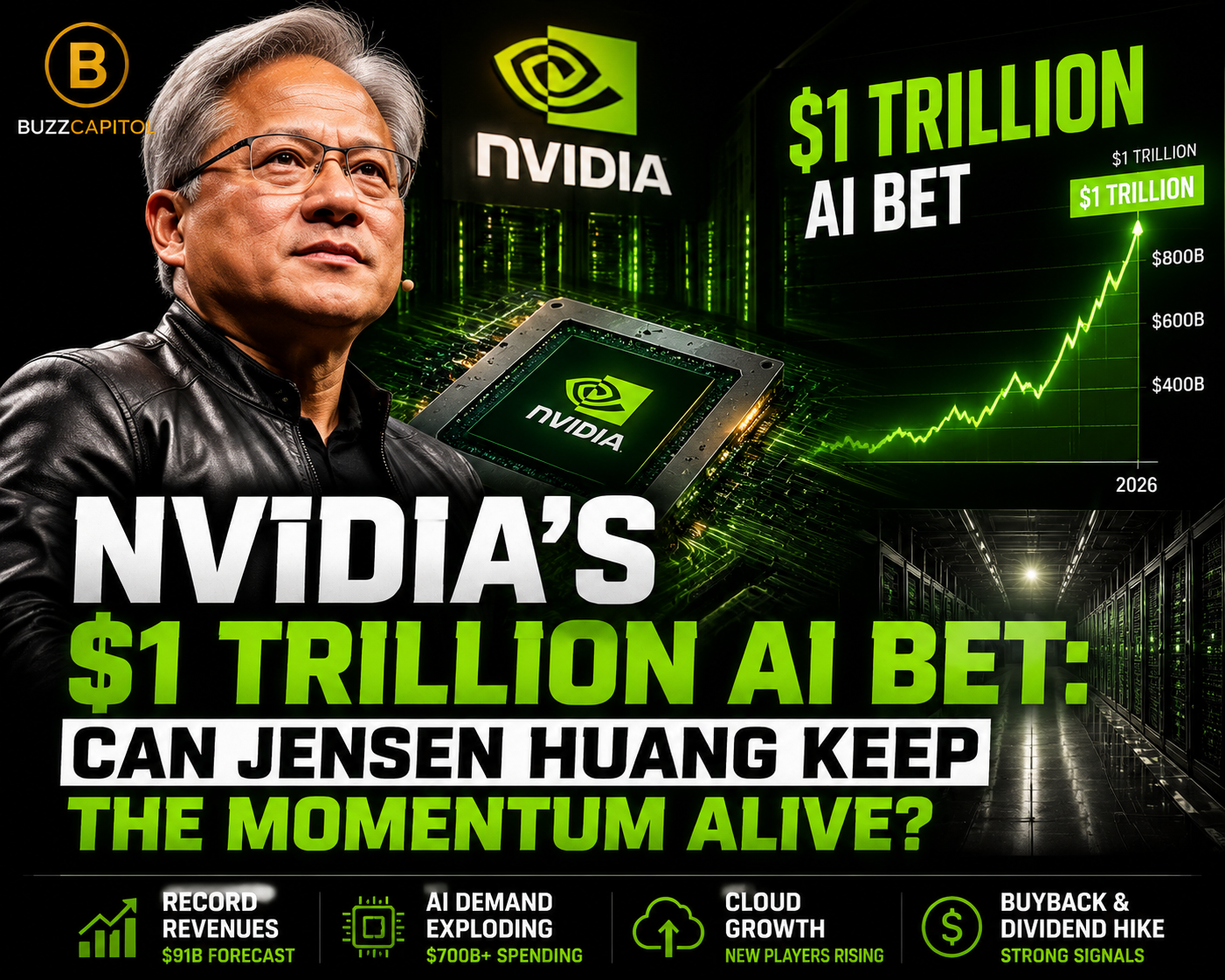
Scrolling through my portfolio last week, I felt that familiar mix of excitement and nervousness. Nvidia had just dropped its latest earnings, and honestly, it felt like the whole tech world held its breath. By May 2026, the conversation isn’t “is Nvidia growing?”—it’s “can they keep dominating while everyone else builds their own AI chips?”
Jensen Huang thinks the answer is a resounding $1 trillion “yes.” But even as shares dipped slightly after hours, it’s clear the market is asking the hard questions.
Table of Contents
The “AI Infrastructure” Gold Rush
Here’s the reality: 2026 is the year of AI infrastructure, and the giants—Alphabet, Amazon, Microsoft—are pouring over $700 billion into it. Just a year ago, it was $400 billion.
Nvidia is the “picks and shovels” provider for this gold rush. Their GPUs aren’t just for training AI models—they’re becoming the backbone for inference workloads, powering real-world AI at scale. But here’s the catch: everyone wants a piece, and competitors are moving fast.
Why the Market is Nervous
Even after Nvidia reported $91 billion for Q2 (beating the $86 billion estimate), the stock wobbled. Why?
- The Competition: Google, Amazon, AMD, and Intel are aggressively building custom chips to reduce dependency on Nvidia.
- Inference Shift: Day-to-day AI workloads can run on cheaper, specialized silicon, reducing reliance on high-end GPUs.
- Pricing Pressure: Markets expect perfection every quarter—good news can already be “priced in.”
| Company | How They Challenge Nvidia |
|---|---|
| Amazon/Google | Building custom chips to cut costs |
| AMD/Intel | Targeting inference market aggressively |
| Microsoft | Balancing Nvidia reliance with internal hardware |
This table helps readers quickly see who’s pressuring Nvidia and how.
Huang’s “Hidden” Growth Engine
Huang isn’t sweating it. He’s betting on AI-focused cloud providers. These smaller, agile firms are buying Nvidia chips at record pace because they need raw compute power to compete. Even as hyperscalers grow their budgets, these nimble companies are driving Nvidia’s margins and adoption faster than expected.
Should Investors Be Concerned?
If you hold NVDA, the dividend increase (from 1 cent to 25 cents) and $80 billion buyback are comforting signals. Nvidia has cash, credibility, and a moat. But the real question isn’t next quarter—it’s 2027 and 2028.
Can Nvidia maintain its dominance as more companies attempt to build their own chips? That’s the test, and investors are watching every quarterly report for hints.
Takeaways From My Hands-On Perspective
Having analyzed AI infrastructure and watched Nvidia closely this year, here’s what I’ve learned:
- Diversification is key: Don’t bet only on hyperscalers—watch smaller AI startups driving Nvidia adoption.
- Market sentiment can swing: Even great earnings can trigger dips if expectations are sky-high.
- Watch the moat: Nvidia isn’t just selling GPUs—it’s selling the ecosystem: software, optimized libraries, and data center partnerships.






Leave a Reply