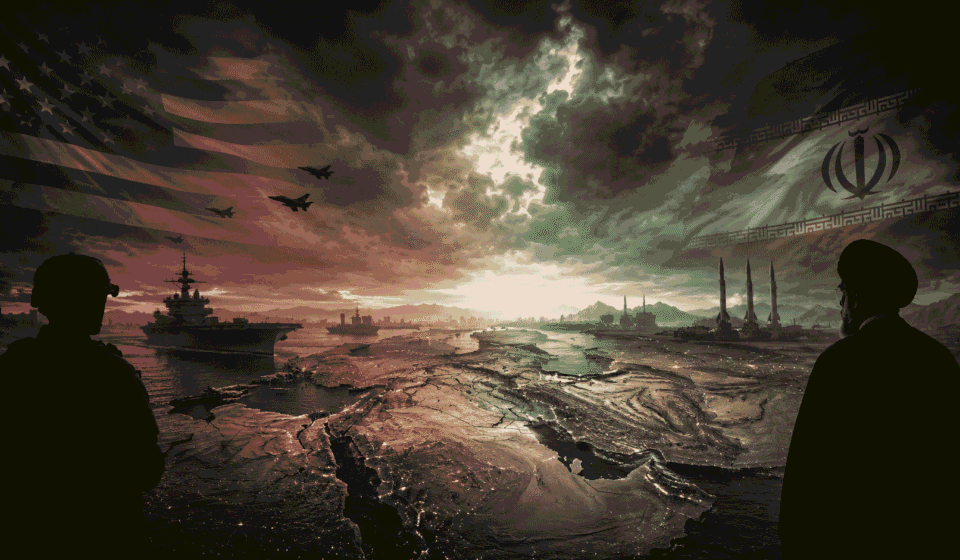
War Between Iran and America: What’s Really Happening and Why It Won’t Stop
I recall sitting with the my uncle in 2020 when a chief Iranian military commander has been killed by a US drone. He looked at me and said, “This is the beginning of wars! History had shown itself to be a cycle and he had seen enough of it this time around. I’m dubious that I’d say at the time. After a 6-year period cognizant of what he meant.
The tension between Iran and the United States didn’t start recently. It was not at any one missile or nuclear deal. It’s not new and if you want to, you have to know what’s below it.
How We Got Here
Most of the people know about the relations between Iran and the US about 2015, when the nuclear deal was concluded, or perhaps from around 2019, when relations became needlessly confrontational. However, the history of the movement dates back to 1979, when the Iranian Revolution toppled a US-backed government and its militants took 52 American diplomats hostage for 444 days.
That moment, that, even now, that moment will not heal. All the confrontations since then have been burdened with that baggage.
The US and Iran engaged in a shadow war in the Persian Gulf through the 1980’s. During the 2000s, Iran felt its power grow in Iraq, Syria, Lebanon, and Yemen countries in which the US was also strongly involved. By the 2010s, Iran’s nuclear program had become the hot subject and years of negotiations, sanctions and failed accords occurred.
The turning point was supposed to be the nuclear deal of 2015, formally known as the JCPOA. Iran inked an agreement to curb its nuclear program in return for relief of sanctions. It worked, briefly. In 2018 the US abandoned this pact, imposed strict new sanctions, and the escalation spree began once more.
Table of Contents
The murder that shook the world.
One of the most powerful military officials in Iran and the brains behind its regional influence network, General Qasem Soleimani, was killed by a US drone strike near Baghdad airport in January 2020. Iran termed it an act of war. The U.S. said it was a purely defensive action to an imminent threat.
Days later, Iran has attacked U.S. military bases in Iraq with ballistic missiles in response. More than 100 American servicemen were reported to have sustained a traumatic brain injury. There was then a backlash from both sides, and there was no way that the relationship could be salvaged.
It was a missing but important element, and it was a “wow” moment for both countries: neither wanted war, but both were willing to take military action seriously against one another. It’s been the same state of affairs ever since. Build up, retreat and build up again.
Discussing the Proxy War No One Is Talking About Much
The past few years have seen the US and Iran engaging in a covert war against one another this is what most news coverage does a poor job of explaining. They do it by way of proxy.
Iran supports and finances the aforementioned groups in the Middle East including Hezbollah in Lebanon, the Houthis in Yemen, and militias in Iraq and Syria under the banner of Hamidieh. Israel, the Gulf Arab states and Kurdish forces are symbols of America’s support. These groups are in conflict with one another, and when they engage in conflict, Iran and America are at virtual war with one another with a step removed.
That is why the fighting in Gaza, the Houthis’ attacks on Red Sea shipping and the attacks on U.S. bases in Syria and Iraq are all related to the Iran-U.S. relations. It’s a battle on several fronts.
In late 2023 and in 2024, as the Houthis began targeting commercial vessels with drones and missiles in the Red Sea, the Americans took retaliatory action by attacking the group in Yemen. Iran has denied any involvement in the attacks. However, you could feel the bond in everyone.
The Nuclear Question
At the top of the list of U.S. fears toward Iran is a weapon of mass destruction a nuclear weapon. Iran has never officially admitted it is going for one, but its uranium enrichment surpassed levels without civilian purpose. By 2025-2026, Iran will possess enough highly enriched uranium for technically developing a weapons-grade stockpile, although producing and delivering a workable weapon is a different and more complicated process.
Israel, which viewed the prospect of nuclear Iran as existential, has actually been engaged in a variety of stealthy attacks on the Iranian nuclear program for years: assassinations of Iranian scientists, sabotage of Iranian facilities and cyberattacks. Some have been endorsed, and some denied, by the US.
For years, Washington policymakers have been split over a potential negotiating agreement with Tehran on a new nuclear accord or military measures to set Iran’s program back. There is no good solution. Strikes might cause setbacks in the programme but would certainly further inflame the regional situation big time. Both sides don’t seem inclined to make public concessions that are hallmarks of diplomacy.
What ‘War’ is Really Like Now
Those people who type in the phrase ‘war between Iran and America’ want to know if a war is occurring or will shortly between the two nations. A low-level war has been growing for years, but an outright conventional war the kind with front lines and mass casualties on both sides did not occur, and both sides have been careful not to make it happen.
It’s for practical reasons on both sides.
If the US went to war against Iran, it would confront a force of 90 million people, a well-informed military, an abundance of ballistic missiles, as well as the capability to close the Strait of Hormuz which transports approximately 20% of all of the world’s oil. Its economic impact alone would be world devastating.
To Iran, direct war with the U.S. would effectively equate to war without nuclear deterrence and the country’s military is by far the least powerful on the planet. The Iranian government is well aware that it can’t prevail in that conflict with conventional force, hence an asymmetric warfare strategy, designed to make engaging with the Iranians too expensive to risk for the U.S.
The Moments that I Watched Most Closely
I do have been monitoring this conflict for years, by way of open-source intelligence posts, foreign policy publications, local media, and so on. A handful of moments were truly perilous:
During the summer of 2019, after Iran downed a U.S. surveillance aircraft in the Strait of Hormuz. The US was on the verge of launching counterattacks but backed down.
Based on the combined accounts of at least five major direct missile and drone attacks that Iran carried out against Israeli territory in the past year, including a record number of missiles and drones launched in April 2024. Most of them were successfully diverted by Israel, with U.S. aid. Iran was essentially declaring, “we can get to Israel.Iran essentially was proclaiming, “we can get to Israel. This adjusted the strategic equation for all concerned in the region.
Each of these instances unfolded in the same way: steps were ratcheted up and then an equally conscious move by both parties not to take the next step. But each also furthered the threshold of what is “normal” or normalizing a step closer to open conflict.
Appreciating the Arts of Everyday Living.
The most typical error I observe in debates of this kind is if this conflict is simply binary: there is or isn’t a war. The actual situation is more complicated. There’s a continuum of conflict and Iran/U.S. have been in this middle ground for a good many years.
Another error is supposed “ideological. Yes, there are true differences of ideal. But much of what is propelling Iran’s foreign policy is strategic – retaining influence in the region, fending off regime change, resisting economic pressures. A lot of their interests that affect the policy of the US are related to Israel’s security, oil markets, and not wanting to get involved in yet another long Middle-East war.
From the outside the behavior may appear chaotic, but if you know the intentions of both parties, the actions are more predictable.
What do you, as an American, need to know about the world?
If you prefer to avoid all the noise, there are a couple of ways I’ve found to keep up with this one:
Go with NOAA’s equivalent for geopolitics that is, primary sources. The IAEA reports about Iran’s nuclear program are accessible to the public and provide more information than most news summaries. But look at what the US State Department and Iran’s Foreign Ministry say about each other: They tell you where the pain points are.
The Institute for the Study of War has daily updates on regional conflict. Foreign Affairs and War on the Rocks also have long form pieces written by those who really study this stuff for a living.
Do not present pre-state media, no matter from which country, no matter which country it is an obviously politically aligned media, as a neutral source. Cross-reference everything.
Where Things Stand
The situation is persistently unstable but manageable up to mid-2026. Diplomatic back-channels operate even when these statements are maximalist. Both governments are feeling pressures on the domestic scene to resort to rhetoric, but both have also learned about the real price of real war.
There’s no reason it couldn’t take place. What really matters is miscalculation a knock that goes too far; a provocation that leads to a counter-provocation that leads to a reaction. Over the years the marges have reduced in width.
My uncle was correct, escalation does seem to be part of a pattern. He also knew that the pattern does not predict an outcome. This one’s still in progress.